Introduction
For years, the financial world operated in two distinct silos: Traditional Finance (TradFi), characterized by centralized banking, slow settlement times, and rigid structures, and Decentralized Finance (DeFi), known for its transparency, speed, and 24/7 accessibility. As we move through 2026, those walls are rapidly dissolving. We are witnessing a fundamental shift toward “Hybrid Finance,” a system where the reliability of real-world assets meets the technological efficiency of blockchain. The adoption of hybrid finance will likely redefine global market liquidity.
Table of Contents
Bridging the Gap
In the early days, blockchain was viewed by many institutional players as a speculative experiment. Today, the conversation has moved from “Why should we use it?” to “How do we scale it?”
The catalyst for this shift is the integration of Real-World Assets (RWA) into the decentralized ecosystem. By bringing assets such as government bonds, corporate credit, and commercial real estate on-chain, financial institutions are solving the two greatest challenges in finance: liquidity and operational friction. As the ecosystem matures, the adoption of hybrid finance will likely redefine global market liquidity.
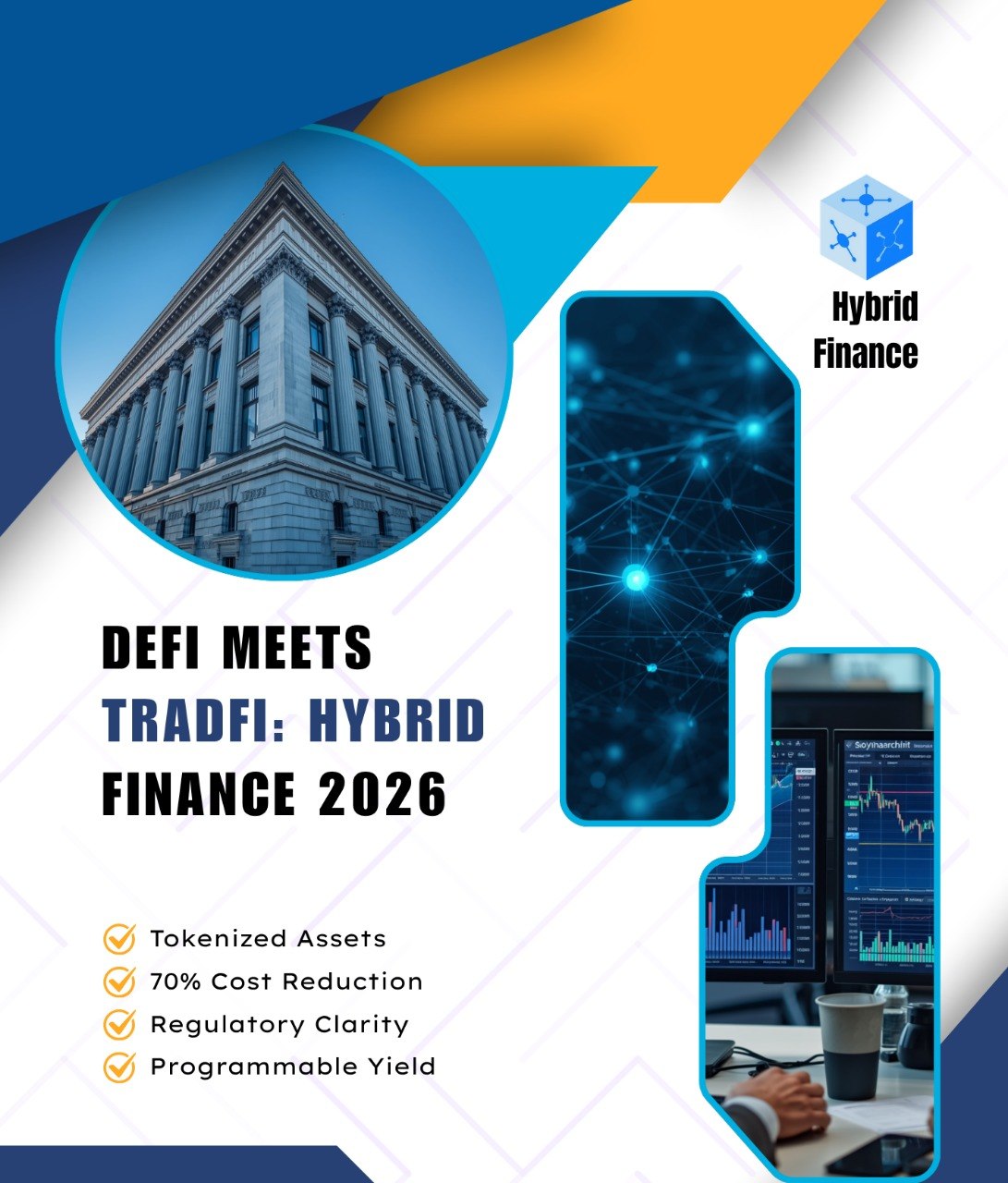
When a treasury bond is tokenized, it no longer requires a two-day clearing process. Instead, it moves instantly, transparently, and around the clock. For major asset managers, this isn’t just a technical upgrade; it is a way to reduce operational costs by over 70% while opening new, global liquidity pools that were previously inaccessible. Investors seeking to capitalize on this liquidity shift are already utilizing the 7 Lucrative RWA Tokenization Strategies we have outlined previously.
Why 2026 Marks a Turning Point
Three primary factors have combined to make 2026 a defining year for this convergence:
• Regulatory Clarity: Global frameworks in the EU, the US, and Singapore have solidified. Institutions are no longer operating in a legal gray area; they are building on a foundation of “regulated compliance.” This has unlocked institutional capital that had been sitting on the sidelines waiting for certainty.
• Infrastructure Maturity: We have moved beyond the “hype” phase. Today’s platforms focus on enterprise-grade custody solutions, auditability, and institutional-level security. We are building “permissioned” environments meaning that while the ledger is blockchain-based, the participants are vetted, verified, and compliant.
• Programmable Yield: DeFi has always offered innovative yield mechanics, but they were often tied to volatile crypto-native tokens. Now, RWA tokenization brings “real-world yield” (like interest from government securities or rental income) into DeFi protocols. This creates a hybrid model where investors get the security of traditional fixed income with the composability of smart contracts.
The Challenges Ahead
While the momentum is unmistakable, the industry still faces hurdles. The “Trust Gap” remains a legacy of early-stage hacks and market collapses which necessitates a relentless focus on technical security. Furthermore, there is an Educational Barrier.
Research from the OECD suggests that financial literacy regarding digital infrastructure is still lacking among the general population.
The industry is responding with partnerships between academic institutions and blockchain firms, ensuring that the next generation of financial professionals understands that blockchain is not “crypto” it is the future of financial infrastructure. This move toward permissioned, institutional-grade environments follows the massive Institutional Pivot we analyzed in our previous report.
Furthermore, the integration of hybrid finance is not just a technological hurdle; it is a fundamental shift in how trust is distributed in a global market. By decentralizing the verification process while maintaining institutional standards, we are building a financial system that is resilient to localized failures and optimized for global scale. This is not the end of traditional banking it is the evolution of it into a more efficient, accessible, and transparent infrastructure that benefits every participant, from retail investors to global sovereign wealth funds.”
What This Means for You
Whether you are an investor, a trader, or a professional looking to pivot your career, the takeaway is clear: don’t treat blockchain as a separate asset class; treat it as the new standard for the entire financial sector.
The winners in this new era will be the platforms and individuals that make these technologies “invisible.” When you can move capital across borders or buy fractional shares of a commercial building as easily as sending an email, the technology has succeeded. We are reaching that point of invisibility, where the blockchain becomes the engine room, and the focus returns to what matters most: efficiency, transparency, and access.
As the industry shifts, there is a rising demand for professionals; check our guide on High-Paying Web3 Careers to see how you can fit into this new financial architecture. To succeed in this hybrid world, you don’t need to be a developer. Focusing on the 5 Lucrative Web3 Skills that require zero coding is the best way to gain a competitive edge.”